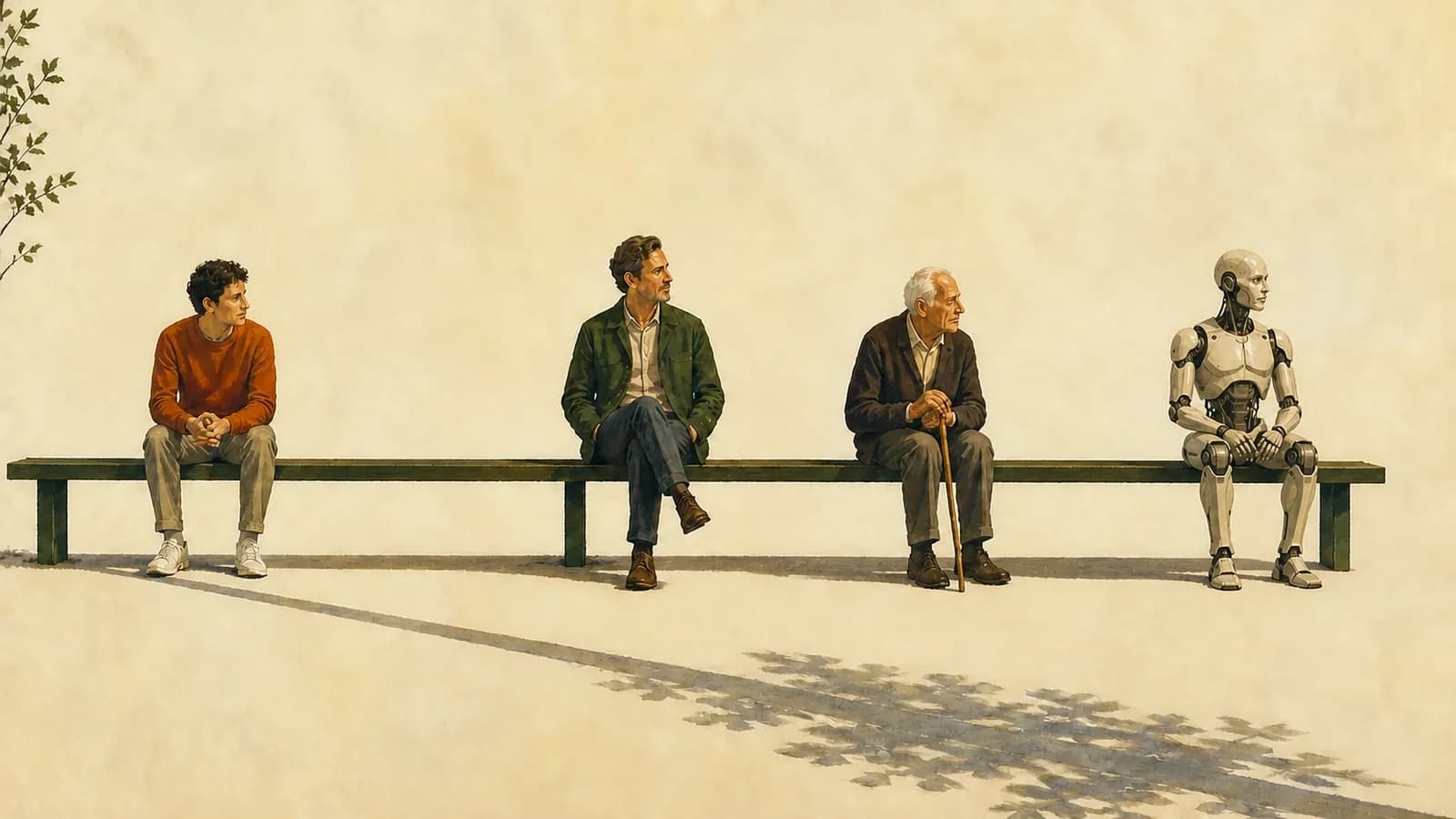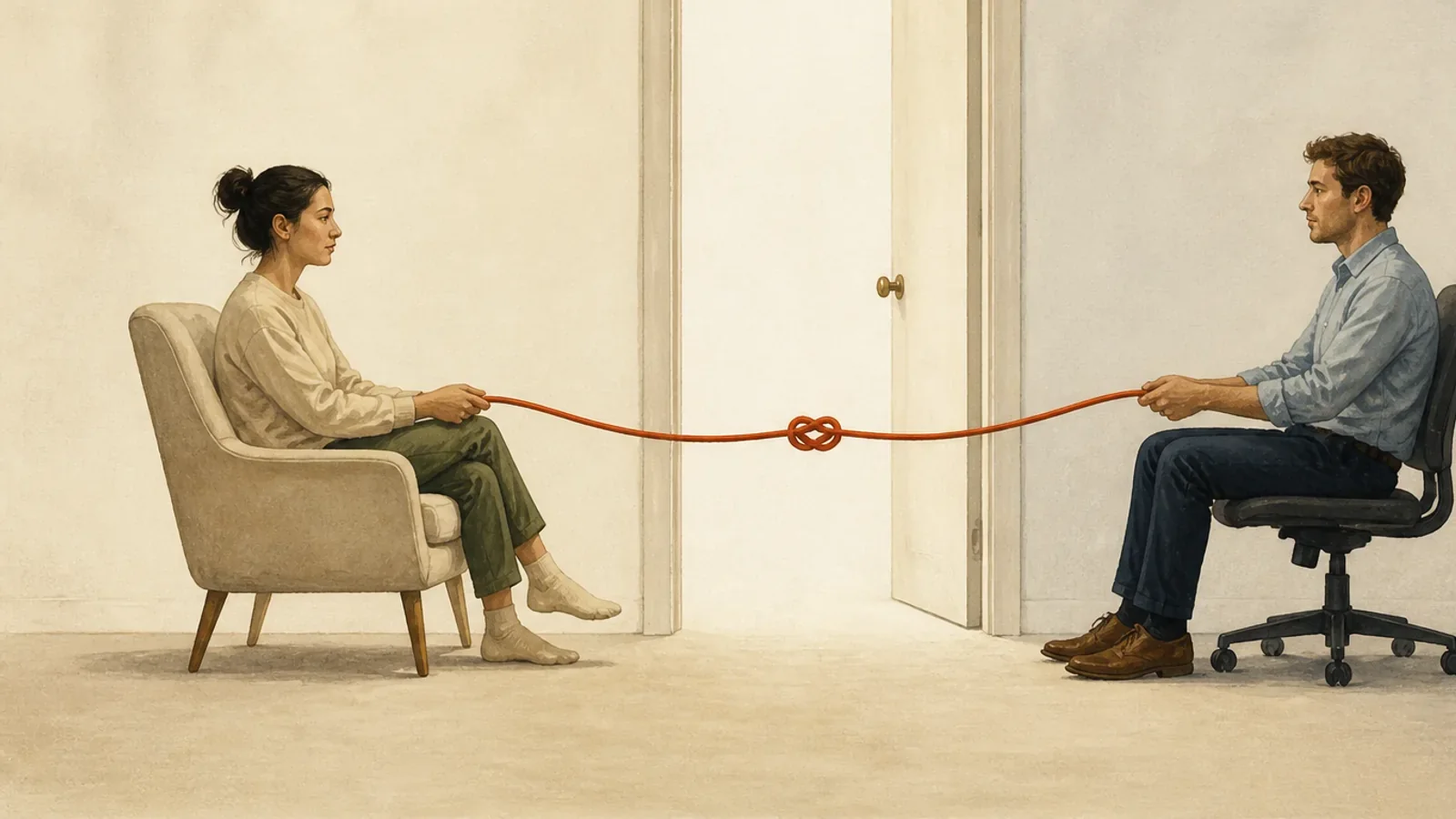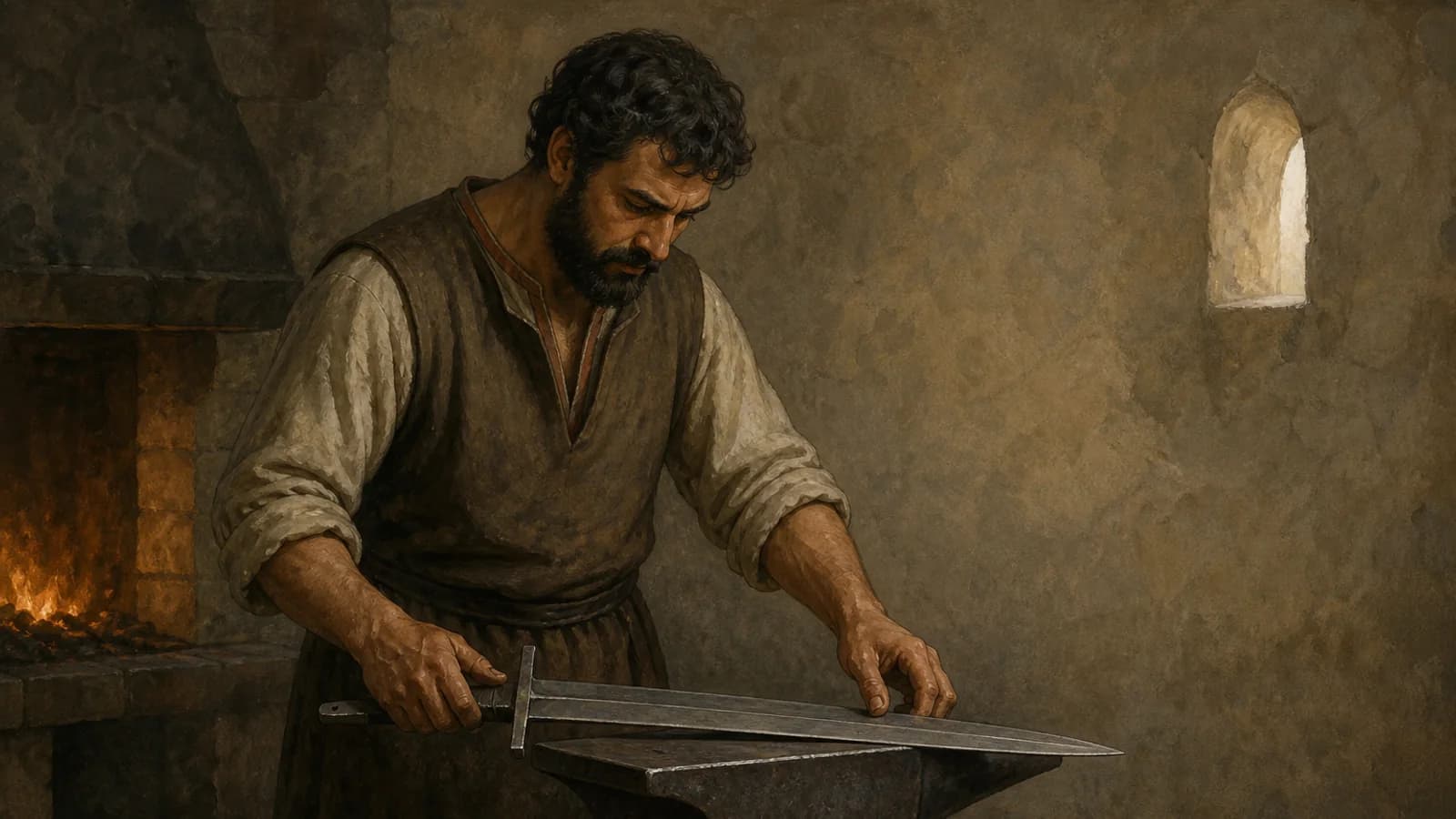
Artists have always enjoyed calling businesspeople greedy. It is one of the reliable pleasures of making things, this sense of having opted out of the rat race, of pursuing something meaningful while the suits chase a number that will never be high enough. The framework appears in novels and films and songs with some regularity, because novelists and filmmakers and musicians are the ones who get to tell the stories, and they tend to cast themselves as the protagonists. The suit is the villain. The creative is the hero. The suit wants money and the creative wants meaning, and these desires are understood to be fundamentally different in character, one craven and the other noble.
The critique of wealth-seeking is ancient, older than capitalism, older than coinage probably, appearing in Ecclesiastes and in the Stoics and in every religious and philosophical tradition that has thought seriously about what makes a life go well or badly. The rich man is filling a hole that cannot be filled with money. His hunger grows with feeding. He is chasing something that recedes as he approaches, and he will chase it until he dies.
But there is a version of this critique that lets artists off the hook too easily, that assumes the hunger for recognition is somehow different from the hunger for wealth. Purer, maybe. More justified. Pointed at something real instead of something empty.
This seems worth examining.
I.
The arc of financial ambition is well documented, almost clichéd at this point, the subject of religious sermons and commencement speeches and think pieces beyond counting.
A person starts in debt, with student loans or credit cards or both, and they think: if I could just get to zero, just get my head above water, I would be satisfied. Zero seems like the promised land when you are negative.
Then they get to zero, and zero turns out to feel like the new baseline, the new floor from which to measure inadequacy. Now they think: if I could just have enough for a comfortable life, enough for nice meals and decent clothes and a dating life that doesn't require constant financial anxiety, that would be enough, that would be success.
Then they get there, and the comfort curdles into a new dissatisfaction. Now they think: if I could just own a home, just have some equity instead of paying rent to a landlord, just have a place that is mine, that would be enough.
Then they buy the home, and within a year they are thinking about a bigger home, or a second home, or renovations to the home they have. Now they think: if I could just have investments, just have some capital working for me instead of working for capital, just have enough that the dividends cover some meaningful portion of my expenses, that would be enough.
Then they get there, and it turns out not to be enough. The number keeps moving. Ten million to be taken seriously in certain rooms. A hundred million to be in the room where decisions happen. A billion to be someone whose name people recognize without context. Each threshold, once crossed, reveals a new threshold behind it, and the thresholds do not end, because there is no number after which the hunger stops. The billionaire keeps working. The hedge fund manager cannot retire. The entrepreneur sells one company and immediately starts another, not because she needs the money but because she does not know who she is without the chase.
This pattern is so familiar that pointing it out feels almost tedious. Yes, we know, money cannot buy happiness, the love of money is the root of all evil, and so on. The critique has been made so many times that it has become a kind of background radiation, a truth so widely acknowledged that it changes nothing about how anyone actually behaves.
But here is the thing. The artists who make this critique, who have always made this critique, who position themselves as the ones who have seen through the illusion of wealth and chosen something more authentic instead, are often running the same software. The currency is different. The mechanism is identical.
II.
The young writer starts by wanting to be published, just published, anywhere, by someone other than themselves.
A literary magazine would be enough, or an online journal, or a zine stapled together in someone's apartment with a circulation of two hundred. If they could just see their words in print, validated by an editor who chose them over someone else, they would be satisfied, they would have made it. The publication itself, any publication, seems like the promised land when you are unpublished.
Then they get published in a small journal, and it feels good for a week, maybe two, and then the glow fades and they notice that nobody they know has heard of this journal and it is not clear that anyone actually read the piece, and it turns out not to be enough. Now they think: if I could just get published somewhere that people have actually heard of, somewhere with a reputation, somewhere that would make my parents understand that this is a real thing I am doing, that would be enough.
Then they get published in a magazine with a reputation, and the glow lasts a little longer this time, maybe a month, and they put the link in their email signature and wait for their life to change, and their life does not change, and it turns out not to be enough. Now they think: if I could just get published in The New Yorker, or The Paris Review, or n+1, somewhere in the actual canon of places that matter, that would be enough, that would mean I am a real writer.
Then, if they are talented and persistent and lucky, they get published in one of those places, and it feels like arrival for a season, and they mention it at parties and watch people's eyebrows rise in a gratifying way, and then the season ends and they have to write something else and the publication is now in the past rather than the present, and it turns out not to be enough. Now they think: if I could just get a book deal, just have a whole book with my name on the spine, something that exists as an object in the world, something that will be in libraries after I am dead, that would be enough.
Then they get the book deal, and it is with a small press, and they are happy until they realize that the advance is $8,000 and the book will not be reviewed anywhere that anyone reads and none of their friends who are not writers will ever encounter it, and it turns out not to be enough. Now they think: if I could just get a book deal with a real publisher, one of the Big Five, with an advance large enough to signal that the publisher actually believes in the book, that would be enough.
Then they get that deal, and the advance is respectable, and the book comes out and gets reviewed in a few places and sells modestly, which is what most books do, and it turns out not to be enough. Now they think: if the book could just win something, just get some official recognition that it is not just published but distinguished, that would be enough.
I could keep going, because the ladder keeps going. There are awards that matter and awards that do not. There is the Pushcart Prize and there is the Pulitzer. There is the National Book Award longlist, which is an honor, and then there is actually winning the National Book Award, which is a different thing entirely. There is being a writer and there is being a famous writer. There is the MacArthur Fellowship, the so-called genius grant, which is the closest thing American letters has to a formal anointing, and I am certain that somewhere there is a MacArthur recipient who still feels underrecognized, still believes the culture has not fully understood what they have done.
III.
Or consider comedy, where the ladder is even more visible because the rungs have names that everyone in the industry knows.
A person starts doing open mics in their city, performing five minutes of material for an audience consisting mostly of other people waiting to perform five minutes of material. The rooms are bad and the crowds are indifferent and the whole enterprise feels like it might be a waste of time. But if they could just get a regular spot, just be invited back by the booker instead of signing up on the list each week, that would mean something.
Then they get the regular spot, and it turns out not to be enough. Now they think: if I could just get on a house team somewhere that matters, UCB or Second City or iO, somewhere that would give them stage time and a credential they could point to, that would be enough.
Then they get on a house team, and it feels significant for a while, and then it becomes just the thing they do on Tuesday nights, and it turns out not to be enough. Now they think: if I could just get a manager, someone who believes in them enough to stake their professional time on their success, someone whose job it is to help them get opportunities, that would be enough.
Then they get a manager, and the manager sends them on auditions, and they do not book the auditions, and it turns out not to be enough. Now they think: if I could just book something, anything, a commercial or a co-star role on a procedural or a web series with an actual budget, something that would go on a reel, that would be enough.
Then they book a commercial, and it runs for a few months, and their friends see it and send congratulatory texts, and then it stops running and the texts stop coming and the commercial recedes into the past, and it turns out not to be enough. Now they think: if I could just get staffed on a show, just be in a writers' room, just have the credential of being a professional television writer rather than someone who does comedy while working another job, that would be enough.
Then they get staffed, and they are a staff writer, which is the bottom of the hierarchy, and their pitches get politely ignored and their scripts get rewritten by people with more experience, and they realize that being in the room is not the same as mattering in the room, and it turns out not to be enough. Now they think: if I could just get promoted, just become a story editor or executive story editor, just have a title that indicates I am not entry-level anymore, that would be enough.
And here the ladder continues upward through the producer titles that structure television careers. Executive story editor, co-producer, producer, supervising producer, co-executive producer, executive producer, showrunner. Each rung requires years to reach. Each rung, once reached, reveals the rung above it. The supervising producer wonders what it would be like to be a co-EP. The co-EP wonders what it would be like to run a show. The showrunner wonders what it would be like to have a hit, and the showrunner with a hit wonders what it would be like to have two hits, and somewhere at the top of this particular pyramid there are people like Shonda Rhimes or Ryan Murphy who have built empires and won every award and been profiled in every magazine, and I would bet money they are still hungry for something, still aware of some recognition they have not yet received.
IV.
The internet was supposed to change this. It democratized distribution in ways that would have seemed miraculous to earlier generations of artists. You did not need permission anymore. You did not need a gatekeeper to select you, an editor to approve you, a label to sign you. You could record an album in your bedroom and put it on Spotify. You could write an essay and publish it on Substack. You could make a short film and upload it to YouTube. The work could find its audience directly, without intermediaries.
And this did change things, but not in the way the early optimists imagined. What happened was that the ladder did not disappear. It became more granular, more precisely quantified, more impossible to ignore.
Now you can see exactly how many people read your essay, not approximately but exactly, updated in real time. You can see how many people subscribe to your newsletter and compare that number to other newsletters in your category. You can see how many followers you have and how many followers the person you consider your peer has and how many followers the person you consider your rival has. The metrics are always available, one click away, a live feed of where you stand in the hierarchy of attention.
And it turns out that none of these numbers are ever enough either.
The writer with 500 subscribers thinks about what it would mean to have 5,000, because then they would be in a different category, then they could say they had a real audience. The writer with 5,000 thinks about what it would mean to have 50,000, because that is when the platform starts to take you seriously, that is when you can go paid and maybe make a living from this. The writer with 50,000 thinks about what it would mean to have 500,000, because that is when you become a name that people recognize, a brand, someone whose opinion carries weight beyond their immediate readership.
And somewhere at the top of this ladder there are newsletters with millions of subscribers, and the people who write them are worried about their open rates declining, about whether their last piece performed as well as the piece before it, about whether they are still relevant or whether the culture has moved on without them. The number is never high enough. The recognition is never complete enough. The hunger does not stop.
V.
What makes this hard to see is that the artist's hunger feels different from the inside than the businessman's hunger.
The businessman, at least in the caricature, wants money for its own sake, or for the status and security it provides, or for the power it confers. The want is naked and unadorned. He is not pretending to be doing something noble. He is chasing a number, and everyone knows it, including him.
The artist, by contrast, believes they are doing something that matters. They are not chasing money, or not primarily. They are trying to make something good, something true, something that will move people or make them laugh or help them see the world differently. The recognition they seek is not an end in itself but a confirmation that the work has landed, that it has reached the people it was meant to reach, that it matters.
This feels very different from greed. This feels like the opposite of greed. And yet.
If the work itself were enough, the artist would make it and be satisfied. They would not need the publication, the award, the follower count, the retweet from someone famous. They would do the work and the work would be its own reward.
But this is not how it plays out, for almost anyone. The work is not enough. The work needs to be seen, and seen by the right people, and acknowledged in the right ways. The writer does not just want to write; they want to be recognized as a writer. The comedian does not just want to do comedy; they want to be recognized as a comedian. The recognition is not incidental to the enterprise. It is, for many people, the actual point, the thing that makes all the effort worthwhile.
This does not make them bad people. It makes them people. The desire to be seen and appreciated for what you do is close to universal, maybe actually universal, wired into us at some deep level that we cannot override through willpower or philosophy. But it does complicate the clean distinction between the greedy businessman and the pure artist. Both are hungry. Both are chasing something that recedes. Both find that the thing they wanted, once achieved, transforms into a new want that is slightly larger and slightly further away.
VI.
There is something else that bothers me about the artist's critique of the businessman, which is that the critique often misunderstands what businesspeople are actually doing and why.
The caricature is Ebenezer Scrooge, or Daniel Plainview, or Walter White. The businessman as accumulator, as hoarder, as someone who has sacrificed everything human in pursuit of a number. And these people exist, certainly. But they are not the median case.
The median case is an engineer in Baden-Württemberg who makes components for industrial machinery and wants to put his kids through university and maybe have a nice vacation once a year. The median case is a Mormon in Utah who builds software for dental practices and coaches his daughter's soccer team and donates ten percent of his income to his church. The median case is a woman in suburban Tokyo who runs a small business selling handmade ceramics and takes genuine pleasure in the craft and also in the fact that the business allows her to employ her sister-in-law. These people are not Silas Marner. They are not Gordon Gekko. They are trying to build something that provides for their families and maybe, if things go well, for their communities, and they derive real satisfaction from seeing their work help people, whether that means their submersible marine technology or their yoga studio software or their hot sauce or their cloud database.
The artist, watching from Brooklyn or Silver Lake or Hackney, often cannot see this. The artist sees capitalism and assumes rapacity. The artist sees profit motive and assumes spiritual emptiness. But many businesspeople have a relationship to their work that is not so different from what the artist claims to want: they are making something, they are trying to make it well, they hope it will be useful to others, and they find meaning in the making.
Meanwhile, in those same Brooklyn apartments and Silver Lake bungalows and Hackney warehouse conversions, there are people who have organized their entire lives around the pursuit of recognition. They are convinced that their songwriting is on par with The National, that they are as funny as Bill Burr, that they could act as well as Adam Driver if they just had a shot. They are extremely online. They are scrabbling at the edges of some artistic scene, attending the parties and cultivating the relationships and positioning themselves for the break that they believe is coming. They are not building anything that employs anyone. They are not providing for a family or contributing to a community.
Though I should pause here, because I am being too harsh, and I can feel myself doing the same thing I am criticizing, which is flattening a complex population into a caricature.
Many people start this way in their twenties, convinced they are destined for something extraordinary, and then gradually ease into something else entirely. The aspiring graphic novelist ends up writing C++ shaders for an AAA game studio. The would-be auteur filmmaker becomes a wedding videographer who genuinely loves capturing people's happiest days. The poet who was certain she would be the next Anne Carson ends up teaching high school English and discovering that she finds it more meaningful than she ever expected. These transitions are not failures. They are a kind of growing up, a movement away from what-can-this-scene-do-for-me and toward something more reciprocal, more rooted, more nourishing. The dream of being exceptional gives way to the reality of being useful, and it turns out that being useful is not a consolation prize. For many people it is the thing itself, the thing they were actually looking for without knowing it.
So I do not want to suggest that everyone chasing artistic recognition is a narcissist, or that the pursuit is inherently hollow. The pursuit can be a phase, a necessary stage of development that eventually metabolizes into something healthier.
But there is a version of the pursuit that never metabolizes, that calcifies into a permanent grievance against a world that refuses to recognize one's genius, and this version is more common than the artistic community likes to admit. And increasingly, even the pretense of artistic ambition is falling away. The new show "I Love LA" captures something about this. The characters are not even pretending anymore that their scheming is in service of some larger creative vision. There is no novel they are trying to write, no film they are trying to make, no album they are trying to record. There is just the content, the followers, the metrics, the fame. The fig leaf of artistic ambition has been removed, and what remains is pure status-seeking, influencer as end state rather than as means to something else.
The businessman, at least, is making something. The product may be boring, the industry may be unglamorous, but at the end of the day there is a thing that exists in the world that did not exist before, a thing that someone found useful enough to pay for. The content creator is making nothing except their own persona, popularity as the only product and the only point.
VII.
The comedian Bo Burnham has a bit, or maybe it is not a bit, maybe it is something more sincere than that, about how he wanted to be famous when he was a kid, how he used to perform for his family and bask in the attention, and how he eventually achieved the fame he wanted and discovered that it did not fix anything, that he was still himself, still anxious and uncertain, still searching for something that the fame could not provide.
This is an old observation, almost a cliché, the celebrity who achieves everything they dreamed of and finds that the achievement is hollow. But Burnham says something that sticks with me, which is that he cannot tell other people not to want what he wanted, because if you had told his younger self that fame would not make him happy, his younger self would not have believed it, would have assumed this was something that losers said to console themselves, would have kept chasing the thing anyway.
And I think this might be the crux of it. The hunger is not rational. Knowing that the next rung will not satisfy you does not stop you from wanting to reach it. Watching other people achieve the thing you want and remain unsatisfied does not stop you from believing that it will be different for you. The ladder is a treadmill and everyone can see that it is a treadmill and everyone keeps climbing anyway, because the alternative is to stop, and stopping feels like giving up, and giving up feels like death, or at least like a kind of death, a relinquishment of the self you were trying to become.
VIII.
I do not know how to escape this. I am not sure escape is possible, or even what escape would look like. The best I can do is notice the pattern, name it, hold it up to the light.
The artist is not purer than the businessman. The businessman is not more honest than the artist. Both are trying to fill something that resists being filled. Both are climbing ladders that do not end.
Maybe there is something useful in just seeing the mechanism, even if you cannot stop it from running. Or maybe there is nothing useful in it at all, and we are all just stuck here, wanting, in the particular way that our lives have taught us to want.
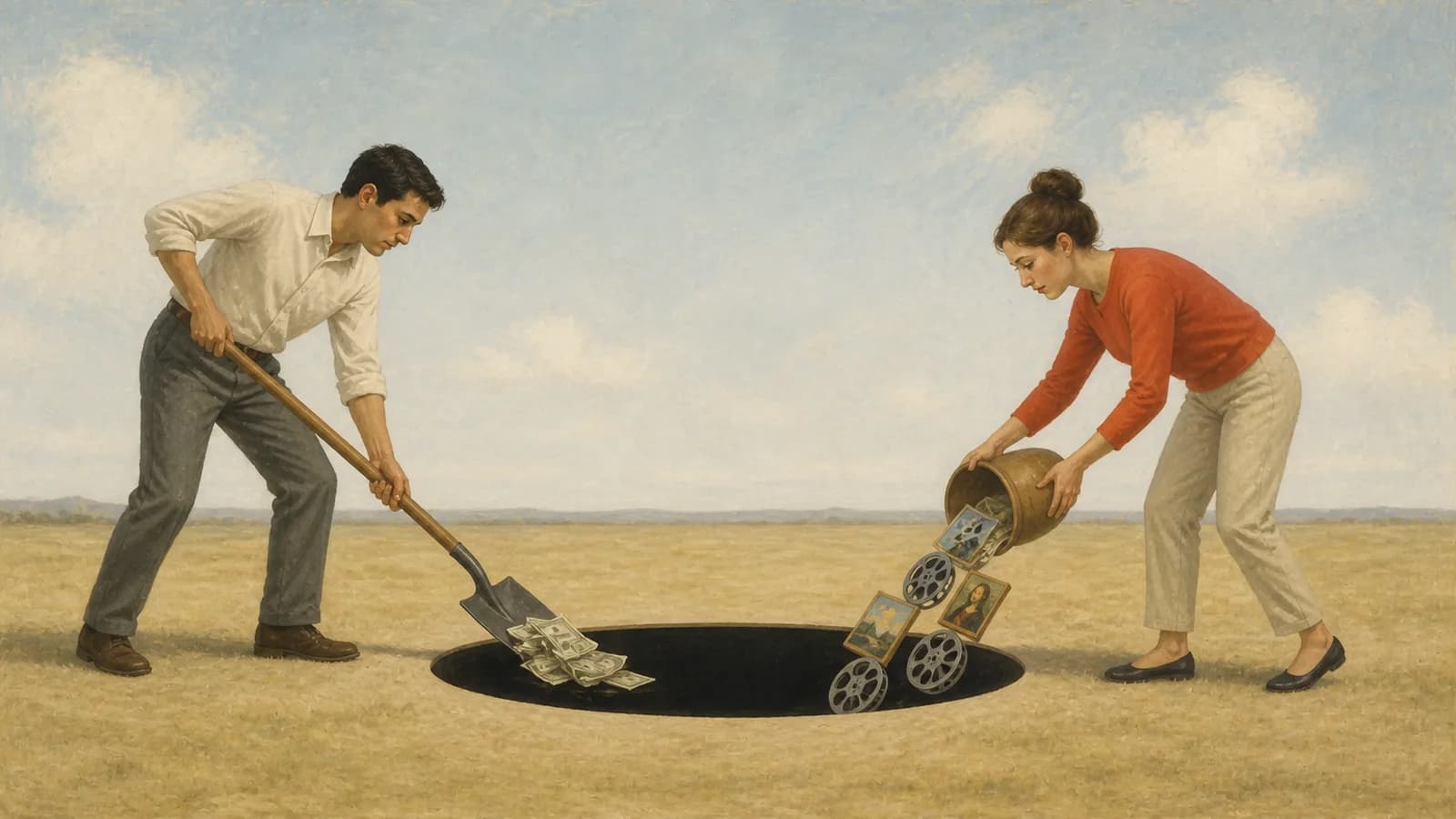
Somewhere right now a writer is refreshing their subscriber count and a founder is refreshing their cap table. The gesture is the same. The hole does not care what you try to fill it with.