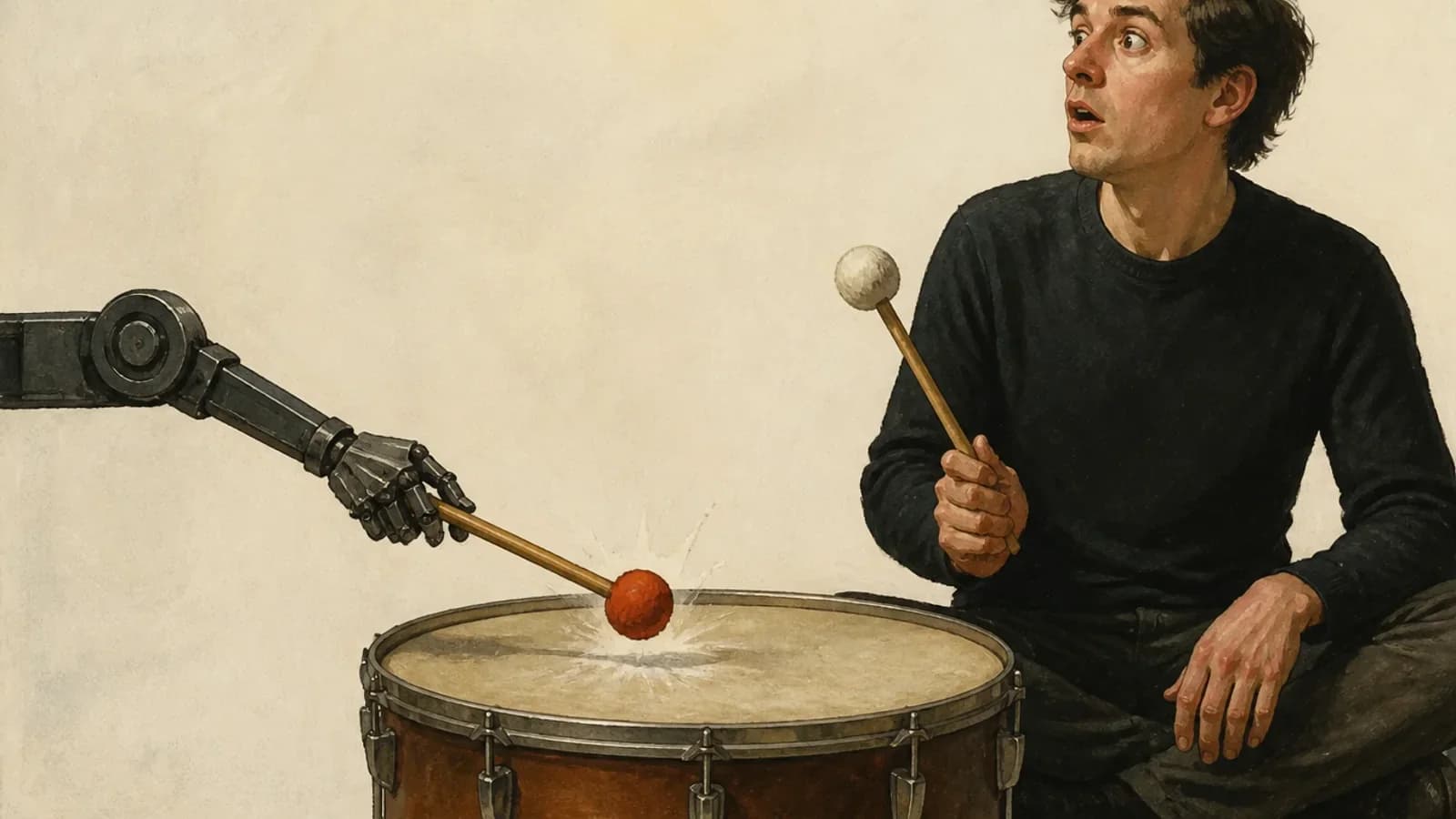
1. The workweek is built around the biological clock. Normal people get tired at 5 PM. Labor laws have evolved around this, and even ambitious executive types eventually kick off by the evening to at least sleep or wind down. With some exceptions (people in their 20s maybe manage a sustained period of "working every waking hour"), this is not true with AI. Companies will look for ways for work to happen 24/7. There will be the concept of losing the night, as in agents are not monitored by humans or getting blocked at night, perhaps by having an antipodal office in an offset time zone to keep agentic work supervised 24/7.
2. The medieval man built cathedrals that took three generations to complete. The AI company ships a product that is obsolete before the press release is edited.
3. Every great media technology has a corresponding vice. Print brought propaganda. Television brought passivity. Cinema brought pornography. The internet brought narcissism. AI will bring something we do not yet have a name for.
4. AI gives you leverage, and leverage amplifies whatever you already are. A disciplined person becomes more productive. A scattered person generates more noise. A dishonest person becomes a more effective liar.
5. The people best positioned to use AI are the people who already know how to do the thing without it. This is an ugly irony nobody in the industry wants to say out loud, because the entire marketing pitch is that AI levels the playing field.
6. The most productive people using AI right now are not technologists. They are domain experts who happen to be curious. A tax accountant who spends a weekend learning to prompt well will get more value out of AI than a software engineer who does not understand tax. The knowledge was always the bottleneck. The tools just finally got out of the way.
7. People keep asking which jobs AI will replace. The better question is which tasks within jobs AI will absorb. Almost no job is 100% automatable. Almost every job is 30% automatable. Some are, in fact, 90-99% automatable. The result is not unemployment. It is a massive, quiet restructuring of what people actually do all day, which will be far harder to see and far harder to build policy around.
8. The executive is a bundle of traits, and AI can replace some but not others.
- Managerial skill. AI can coordinate tasks and track progress. It cannot sense when someone is about to quit.
- An orientation towards shareholder needs, not just "doing the task." AI optimizes for whatever metric you give it. It does not ask whether the metric is the right one.
- The ability to motivate and manage people. No one has ever run through a wall because a chatbot believed in them.
- A willingness to be blamed and take liability, in spirit if not literally legally, although even legally in some cases. A machine can optimize. It cannot be fired. This is its great limitation.
- Drive. AI does not want anything. It does not wake up at 4 AM because it can't stop thinking about the problem.
- Intelligence. AI has this, arguably in surplus.
- Judgment under ambiguity, where the data doesn't give you a clear answer and you have to make a call anyway. AI is excellent when the data is clear. When it isn't, it guesses confidently, which is worse than admitting you don't know.
- Pattern recognition across domains, connecting something you saw fail at a previous company to what's happening now. AI has read about every company. It has not felt a failure in its bones.
- The ability to say no, to kill projects that people are emotionally invested in. AI has no problem saying no. It also has no skin in the game, which is why no one respects the no.
- Political skill, knowing which stakeholders to bring in, when, and in what order. This is almost entirely illegible to AI.
- The willingness to make irreversible decisions on a timeline, because not deciding is also a decision. AI will give you five options with probabilities. You still have to pick one and live with it.
- The ability to hold contradictory priorities (grow fast but don't burn cash, be bold but manage risk) without collapsing into paralysis. AI resolves contradictions. Executives have to live inside them.
Within a few years of this list being written, AI will be able to do some of the things above.
9. We have had a norm that has mostly held true for millennia, with maybe some small exceptions in the last 50 years: children and teenagers generally can't make too much money while they are young. Even bright young students usually needed to go to university. Even the rare actors and musicians (Tom Cruise, the Beatles) still basically broke through after 19. AI changes this. With vibe go-to-market and vibe coding, there is no structural reason a 14-year-old, and many 14-year-olds, can't get rich. Content creation was the first crack in this cultural norm, as many content creators started to see success while underage. It will become harder and harder to "make them wait for maturity." Frankly, many parents will welcome the income.
10. When building a prototype was hard, it filtered out people who lacked persistence and resourcefulness. That filter had nothing to do with business skills, but it correlated with them loosely enough to be useful. AI removes that filter. A lot more people will now get to the stage where the actual hard work begins (distribution, trust, support, reputation) and discover they have no aptitude or appetite for it. The prototype was never the business, and everyone knew that, but it was a decent entrance exam. The entrance exam just got abolished.
11. AI lets you run your business in languages you do not speak. This was theoretically possible before with translators and agencies but practically impossible for a small operation. A five-person company can now sell credibly in German, Japanese, and Portuguese. Some trade barriers that protected small domestic businesses from foreign-language competition are dissolving. Protectionism may push back against this force.
12. Hiring is about to get much worse. Every candidate can now produce a flawless cover letter, a polished portfolio, a confident interview with rehearsed answers to every question. The entire hiring apparatus was built to detect effort and preparation as proxies for ability. When effort goes to zero, the proxies collapse, and we have nothing to replace them with.
13. Seniority used to mean something specific. The senior person had seen things go wrong in ways the junior person had not. They carried institutional scar tissue. AI compresses this because a junior employee with a good AI workflow can produce output that looks senior. But looking senior and being senior are different when things break. The company will not discover who is actually senior until a crisis, and by then it will have already promoted the wrong people.
14. Performance reviews are about to become absurd in a way nobody has figured out. You cannot praise someone for the quality of their writing if you suspect the AI wrote it. Maybe, you can praise how efficiently they spend tokens. You cannot criticize their analysis if you are not sure which parts were theirs. The review becomes a negotiation about attribution and token efficiency, and neither the manager nor the employee has an incentive to be fully honest about where the human ended and the machine began.
15. The loyalty problem runs deeper than people realize. Every employee now knows that their company is actively looking for ways to need fewer people. This is not a secret. It is in every earnings call, every strategy deck. The employee is being asked to enthusiastically adopt the tool that may eliminate their position, and to be a "team player" about it. This is a genuinely strange psychological contract. It's possible there should no longer be an assumption of even medium-term loyalty, because it is destined to be broken by both parties.
16. The best employees are quietly building personal AI systems on their own time, with their own accounts, trained on their own thinking. They use these systems at work but they do not tell their employer the details, the same way a chef brings her own knives to the restaurant. The knives are hers. She sharpens them on her own time. She takes them when she leaves. The question is whether an AI workflow trained on your judgment is a knife or a trade secret, and employment law is not remotely ready for this.
17. The old version of this problem was the salesman who kept his rolodex when he quit. Companies fought about it for decades. The new version is the employee who has spent two years building a personal system of prompts, custom agents, fine-tuned workflows, and curated reference material that makes her three times more productive than anyone else on the team. She will smile politely when IT asks everyone to use the company-approved tools. She will continue using her own.
18. There is a genuine philosophical question here that sounds like an IP dispute but is actually about the nature of skill. If I spend years developing an instinct for how to frame a problem so that AI gives me useful output, is that instinct mine or my employer's? It lives in my head. It is not code. It is not a document. It is a style of thinking that happens to interface well with a machine. Companies will try to claim it. They will fail, because you cannot put a noncompete on someone's cognitive habits, but they will try.
19. The employee who shares her full AI workflow with her employer is doing something her predecessors never had to do: making herself legibly replaceable. If the workflow is documented, anyone can run it. If anyone can run it, her value drops to the cost of training a replacement, which is now very low. Rational self-interest says share just enough to seem collaborative and keep the rest private. Every company that celebrates "knowledge sharing" is going to run into the fact that the most valuable knowledge is now the kind people have every incentive to hoard.
20. Some employees will start to think of themselves less as workers and more as contractors who happen to have a salary (contractors have already thought this way for decades, by the way). They bring their own tools, their own systems, their own AI infrastructure. The job is just a client. This mentality already exists among senior engineers and designers. AI will push it down to mid-career knowledge workers who previously had no leverage to think this way. The employer will feel the shift before they can name it: people are performing well but they do not feel like they belong to the company anymore.
21. The corrosive scenario for employers is not that employees use AI tools the company does not know about. It is that the employee's personal toolkit becomes so good that the company cannot function without it, and does not realize this until the employee leaves and everything subtly degrades. No one can point to what went wrong because the system was never documented. It walked out the door inside someone's head and their personal API keys.
22. A smart employee in 2026 is building two things simultaneously: the output her employer pays for, and the portable system that produces it. The output is the job. The system is the career. She is being paid to build the first while quietly accumulating the second. This is not disloyal. It is rational. Every employee has always taken their skills with them. The difference is that these skills are now tangible, transferable, and worth something on the open market in a way that "ten years of experience" never was.
23. Companies will respond to this by trying to mandate approved tools, centralized AI platforms, monitored workflows. This will work about as well as corporate IT's attempt to stop people from using Dropbox in 2012. The employees who comply will be the ones who do not care enough to build their own systems, which is to say, the less productive ones. The productive ones will route around the restrictions because the restrictions make them slower and they know it.
24. What the employee is really saying when she refuses to hand over her AI stack is something older and more fundamental than any IP argument: this is my mind, organized and made operational, and it is not for sale. I will sell you my hours. I will sell you my output. I will not sell you a replica of how I think. This was always true but it never mattered before because how you think was locked inside your skull. Now it can be exported, and the question of who owns it is going to be one of the defining labor fights of the next decade.
25. The biggest beneficiaries of AI in the short term are not startups. They are boring mid-size companies with clear workflows, lots of repetitive processes, and enough margin to experiment. They just don't get profiled in magazines. Startups are actually harder now.
26. AI will produce a wave of solopreneurs who build profitable businesses and never hire anyone. This is already happening. What nobody is discussing is what this does to the labor market if the most capable people no longer create jobs for others. Entrepreneurship used to be a multiplier. It may become a trapdoor.
27. We are about to find out how much of the economy was essentially information asymmetry. The mechanic who charged you $800 because you didn't know the part costs $40. The consultant who repackaged public knowledge as proprietary insight. AI does not eliminate these people overnight, but it hands the customer a flashlight in what used to be a dark room.
28. Cities compete for head offices because head offices bring thousands of taxable employees who eat lunch, rent apartments, and pay income tax. A solopreneur making $2 million a year from a cabin in Tofino generates the same GDP and almost none of the municipal revenue. Tax systems are designed to harvest value from concentrations of people. AI disperses people. Remote work and AI are a one-two punch to the clustered, downtown-restaurant-patronizing, commercial-real-estate-occupying grand bargain between urban areas, working people, executives, tax bases and government balance sheets.
29. France has a word for it, attractivité, and it is about to be redefined. Cities used to attract companies with tax breaks and infrastructure. Then they attracted talent with culture and quality of life. Now they need to attract individual operators who can live anywhere and who choose based on weather, visa simplicity, time zone convenience, and whether the coffee is good. Municipal strategy starts to look like hospitality marketing.
30. Payroll tax is the quiet giant of government revenue. It scales automatically with employment. It is easy to collect because employers do the paperwork. A world of solopreneurs using AI agents is a world where payroll tax revenue declines while economic output does not. Governments will need to find the money somewhere else, and the options are all politically ugly: consumption taxes, wealth taxes, taxes on AI usage itself. None of them collect themselves the way payroll tax did.
31. The interesting competition will not be between cities. It will be between countries offering residency packages to high-income remote workers. Portugal already does this. So do the UAE, Costa Rica, and Greece. When your workforce is one person and that person can live anywhere, immigration policy becomes economic policy in a way that ministries of labor are not staffed to handle.
32. For most of modern history, technological power required population. You needed millions of people to build an industrial base, a military supply chain, a research ecosystem. AI breaks this relationship. Singapore, Israel, the UAE, Estonia can now punch at a weight class that used to require 300 million people and a continent. The 21st century superpower might have 6 million citizens and no army.
33. America's AI advantage is not its engineers. It is the fact that the major foundation model companies are American and denominated in dollars and subject to American law. This is the new version of the reserve currency. Every company in every country that builds on top of OpenAI or Anthropic or Google has a dependency on American infrastructure that is deeper and harder to exit than any trade relationship. It is SWIFT for cognition.
34. China's AI strategy makes perfect sense if you understand what China is actually optimizing for, which is not beating America on benchmarks. It is making sure that the Chinese economy runs on Chinese models. The point is not superiority. The point is sovereignty. Every country will eventually face this choice and most will not have the resources to choose sovereignty, which means they will become cognitive client states of either Washington or Beijing, and most of them will not frame it that way.
35. The EU regulates AI the way it regulates everything: thoroughly, slowly, and in a way that protects consumers while ensuring that no competitive European AI company can emerge. This is not stupidity. It is a revealed preference. The EU has decided, probably correctly, that it will not win the AI production race and has chosen instead to win the AI governance race. Whether governance without production gives you actual power is the trillion-euro question.
36. A Canadian company in 2030 might be three executives in Victoria, spending $5 million a year on American foundation models, selling to customers in Europe, with a holding company in Singapore. Every dollar of cognitive infrastructure goes to California. Every dollar of profit goes to wherever the tax regime is friendliest. Victoria gets three people who buy coffee and pay property tax. This is what a mid-power economy looks like when the value chain runs through someone else's AI.
37. Those three executives will eventually notice that Victoria's winters are long and its income tax is high and its airport has limited direct flights. Dubai has no income tax, daily flights everywhere, and a government that actively courts exactly this kind of person. Costa Rica has a reasonable cost of living and a digital nomad visa. The executives are not disloyal to Canada. They are responding to incentives, and Canada is offering them very few. The mid-power country that assumes its citizens will stay out of sentiment is making the same mistake that companies make when they assume employees will stay out of loyalty.
38. A mid-power faces two bad options. Depend on American AI and accept that your cognitive infrastructure is controlled by a foreign government that may not share your interests next election cycle. Or mandate a domestic alternative that is worse and watch your workers and companies quietly route around it. The first is genuine vulnerability. The second is the Lada problem: the Soviet Union did not fail because it could not build cars, it failed because everyone knew the cars were worse and the mandate to use them anyway corroded trust in every institution that enforced it. Neither option is clearly worse. That is what makes it a trap.
39. Sovereignty in AI sounds appealing until you calculate the cost. Training a competitive foundation model requires billions of dollars, massive compute infrastructure, and a talent pool that currently lives in San Francisco and London. Canada can afford a national AI strategy. It cannot afford a national foundation model, not a good one. The honest question is whether sovereignty means "we built our own" or "we have meaningful control over our terms of access to someone else's." The first is a fantasy for most mid-powers. The second is achievable but requires a kind of diplomatic creativity that most technology policy departments are not staffed for.
40. The mid-power trap is specific: you are too rich to ignore AI, too small to build your own stack, too proud to admit dependence, and too slow to negotiate favorable terms before the architecture is locked in. Canada, Australia, South Korea, the Netherlands, all sitting in the same chair. The countries that navigate this well will be the ones that treat AI access the way they treat energy policy, as a strategic dependency to be managed, diversified, and hedged, not as a technology to be celebrated or feared.
41. There is a version of this where mid-powers actually win. They do not build foundation models. They build the governance, regulation, trust infrastructure, and sector-specific applications on top of them. Canada does not need to compete with OpenAI. It needs to be the country where AI is deployed in healthcare, mining, agriculture, and public services better than anywhere else. The layer above the model is where the value accrues to the country, and that layer rewards domain expertise and institutional quality, which mid-powers actually have. But this requires admitting you are not going to be the one who builds the engine, and national pride makes that admission very difficult.
42. Small countries with good governance and high English proficiency are about to have a moment. They can adopt AI across their entire public sector in a way that the United States, with its fragmented federal system and 50 different procurement processes, simply cannot. Rwanda could have a fully AI-augmented civil service before California finishes its pilot program. The advantage of being small and coherent was always real. It just never mattered this much.
43. Intelligence agencies are facing something they have never faced before: the tools they use to surveil populations are now available to hobbyists. Facial recognition, sentiment analysis, network mapping, open source intelligence gathering. A motivated individual with a laptop and API access can now do what required a three-letter agency and a classified budget ten years ago. The asymmetry between state and citizen that intelligence work depends on is collapsing, and no one in government is comfortable talking about it publicly.
44. The countries that export labor are going to be hit in a way nobody is modeling. The Philippines built an entire economic sector on business process outsourcing. India built one on IT services. These are exactly the tasks AI handles well. The remittance flows that prop up entire national economies are downstream of jobs that are now automatable. This is not a labor market adjustment. It is a potential balance-of-payments crisis for countries that have no plan B.
45. Diplomacy is about to get strange. When a head of state can use AI to instantly analyze the other side's negotiating position, draft counter-proposals in real time, simulate outcomes across dozens of scenarios, the diplomat's traditional value (experience, cultural fluency, personal relationships) does not disappear but it gets compressed into a much smaller part of the process. The rest becomes a game played between systems, and the country with the better system has an advantage that no amount of personal charm can offset.
46. Defense procurement takes 15 years to deliver a major weapons system. AI model generations turn over in 18 months. A country that commits to a 15-year fighter jet program is betting that the platform will still be relevant when it arrives. A country that invests the same money in AI-enabled autonomous systems that can be rebuilt every two years has a different theory of military power entirely. The defense establishments that adapt fastest will not be the richest ones. They will be the ones with the shortest procurement cycles, which again favors small, agile countries over large bureaucratic ones.
47. There is going to be a new category of failed state: the country that is not poor or war-torn but simply does not adopt AI and falls behind so quickly that it cannot catch up. Not every country that misses the AI transition will collapse, but the gap between countries that integrate it into their economy and countries that do not will widen faster than any previous technology gap, because AI compounds. The country that adopts it gets better at adopting more of it. The country that does not falls further behind every year. This is the first technology where the penalty for being five years late might be permanent.
48. Governance will be the bottleneck of the AI age, not capability. We can build anything. We cannot agree on what to allow quickly.
49. Some professions will become more respected simply because they still require a body in a room. Nursing, teaching, the trades, live performance. Remote work allowed you to abdicate having to maintain "presence as a social and professional skill." Remote work allowed people to undo their belts and relieve themselves of the presentation performance while doing intellectual work, so long as their framed upper half in a video call was passable. This will change.
50. The weirdest outcome of AI might be a renaissance in live, in-person, unreproducible experiences. Concerts, dinner parties, sports, theater, craft markets. Possibly with recording forbidden. When everything digital is abundant and suspect, the things you had to physically show up for become more valuable, not less. The economy of presence is just getting started.
51. The first generation that grows up with AI will treat it the way we treat search engines, automobiles, long-distance telephone calls, washing dishes, and washing clothes. They will not be amazed by it. They will be shocked and annoyed when the process is slow.